AMIRI Authentication: How to Flag a Replica
Within luxury streetwear AMIRI sits near the top of any counterfeiting list, and the era of the crude replica ended years ago. Because the label made its name with denim that is worn down and then mended by hand, leather appliqués and heavy hardware, copy factories have had a decade to rehearse precisely those details. Taken alone, no individual detail is conclusive. The checks below are set out in order of evidential value, opening with the ones that do the heavy lifting and finishing with the ones that barely move the needle. It leans on what the brand publishes on its own product pages and FAQ, plus observations that recur across independent authenticators. Treat it as a method for building a case, which is how careful buyers of amiri clothing actually work.
Look at provenance first, not the seams
Where a piece came from matters more than anything on the garment itself, since route and receipt are exactly what a copy factory cannot provide. Stock comes either from the brand’s own website and roughly thirty-three of its own boutiques or from the retail partners it lists publicly, which include Saks Fifth Avenue, Neiman Marcus, Nordstrom, Bergdorf Goodman, Selfridges, Harrods, Browns, Mr Porter and SSENSE. If a seller appears on none of those lists and is not the official sale channel of one of them, the burden of proof sits squarely on the item. Keep the invoice, because the brand’s own after-sales help depends on having one. One caveat: the stockist page as published is poorly maintained, still naming a retailer that shut down in 2024 alongside shop names that are misspelled. A grey area exists as well, since large marketplaces can hold authentic stock through partner boutiques that are themselves authorised.
- Confirm the seller against the brand’s published stockist list
- Push for the original invoice instead of a screenshot of a product page
- Treat any claim of outlet or official discount pricing as disqualifying
- Ask for photographs of the interior labels, not just the outside
- Check how the asking price stacks up against the observed market range tenis amiri for the very same style
Origin works as a matching test, not as a country test
Almost every authentication guide tells readers to look for a country of origin, and almost every one of them runs the logic backwards. Because production is split by style, the country printed on the label cannot authenticate the brand single-handedly. The signal you want is a mismatch, meaning an origin that does not belong to that particular style. The confirmed pairings are set out below, and they show why a Vietnamese label on amiri sneakers is normal rather than suspicious. Note in passing that the MA Core Logo Tee and the MA Bar Logo Tee are different products with different stated origins. What deserves a second look is a jean labelled Italy, or a Skel-Top labelled United States.
- MX1 jean, Stack jean and MA Core Logo Hoodie: origin is stated as made in the USA
- MA Core Logo Tee: stated as made in Italy
- MA Bar Logo Tee: the stated origin is made in Los Angeles
- Skel Top Low and Skel Court Hi: documented as made in Vietnam
Labels, hardware and the rear leather patch
The rear leather patch is the component authenticators return to most often, and on genuine pieces it reads as real leather that is supple, substantial, cleanly debossed and evenly stitched. Copies tend towards a thin, plasticky material with uneven thread tension and logo geometry that is subtly stretched or squashed. Buttons and rivets should feel solid, sit securely, carry crisp engraving and repeat consistently from piece to piece. Counterfeit hardware usually feels light in the hand, with stamping that is shallow, too large or poorly proportioned. Interior wash and care tags, whether on a jean or an amiri hoodie, carry thin, even lettering at a consistent weight; fakes set the brand name too thick and garble the fabric composition. Rather than random strings, style codes are systematic, taking forms such as PXMD001-018 on the MX1, AMJYHD1050-001 on the MA Core Logo Hoodie and AMFOSR1110-001 on the Skel Top Low, and they should stay internally consistent and match the style and colour.
Distressing is the toughest element to fake at volume
The abrasion and repair work is the actual product, so it is also the element a copy operation struggles most to reproduce cheaply. Genuine amiri jeans carry distressing that is irregular and asymmetric, with wear placed by hand rather than by a template. On the MX1, pleated ovine leather is set into the worn areas, and that panel ought to read as a deliberate structural insert, rather than a patch glued over damage. Thrasher gives you the purely hand-worn expression, abrasion and repair without the structured leather panel; Shotgun, by contrast, carries blown-out frayed holes with sanded edges. Counterfeits betray themselves with repetitive, flat, obviously machine-uniform wear that repeats at the same angle on both legs. The language of materials helps too: the house names ovine leather specifically and gives its core stretch denim as 92% cotton, 6% elastomultiester and 2% elastane.
Weighting the evidence
It matters more to rank the checks than to collect them, since counterfeit quality here is high enough that any one feature can be reproduced. The grouping that follows turns on whether a signal can be corroborated against the brand’s own published information or only against third-party guides. The decisive signals come down to channel and paperwork. High-confidence signals point at the work itself, and the work is expensive to fake convincingly. Components make up the moderate group: they are cheap to improve and therefore drift as copies get better. Low-confidence signals circulate widely without surviving contact with how a fashion house operates, and packaging sits in that group because a box and a dust bag are the easiest elements of all to copy.
| Indicator |
What the genuine article shows |
How much it counts |
| Seller and documentation |
Bought from the brand or a named authorised stockist, invoice included |
Settles it |
| Character of the distressing |
Irregular and asymmetric abrasion and repair, finished by hand |
Strong |
| Origin against style |
An origin that matches that style, rather than any single country |
High value |
| The rear leather patch |
Supple real leather, crisp debossing and even stitching |
Moderate |
| Rivets and buttons |
Solid and crisply engraved, set securely and consistently |
Moderate |
| Interior wash, care and size tags |
Thin lettering, evenly formed, at one consistent weight |
Moderate weight |
| Zipper maker and stitch counts |
Differ from season to season and style to style |
Low value |
| Swing tags, dust bag and box |
The easiest elements of all to copy |
Low |
Where the guides disagree, and what does not exist
A notable proportion of the published authentication content on this brand comes from companies that sell authentication, and a good deal of it is machine-generated and self-referential. Where the guides disagree, the honest response is to note it plainly. One specifies an exact stitch count on the rear leather patch, but that is a single uncorroborated source and should never be used as a pass or fail rule. Another treats a particular zipper brand as proof, which is unsafe because hardware suppliers vary by season and by style. What does not exist matters as much as what does, and on this brand no official authentication service was found, while no brand-operated tag, QR code, digital product passport or authentication app could be identified either. The brand’s own FAQ says it can only verify products bought directly from it or through an authorised stockist partner, and that it cannot authenticate items bought outside those channels, which makes this a proof-of-purchase check for its own customers rather than a public service. Paid third-party authenticators will assess pieces commercially, but their accuracy claims are marketing rather than independently tested results.
Why an outlet claim ends the conversation
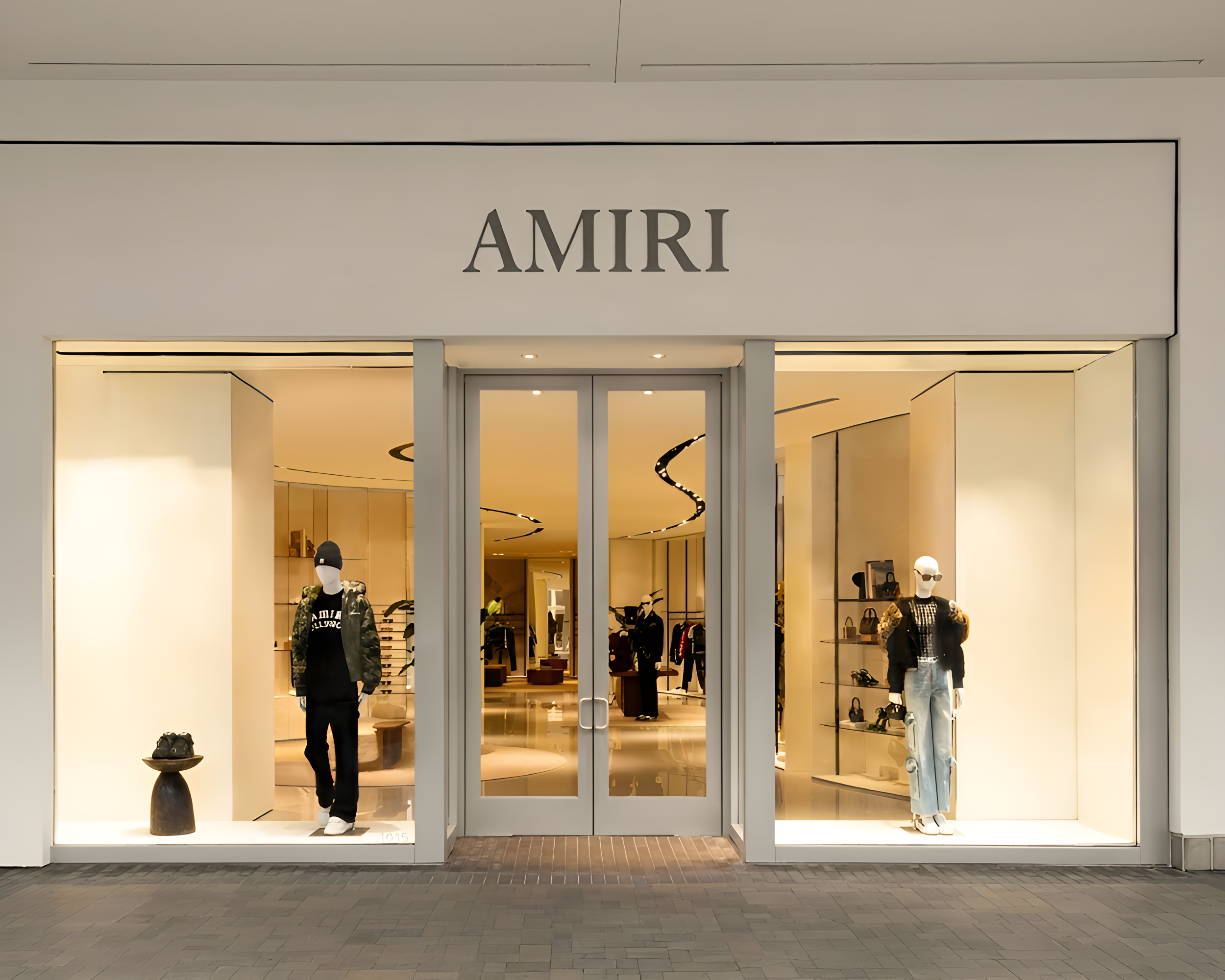
One word disqualifies faster than anything else: outlet. A federal complaint filed in July 2021 in California records AMIRI stating that it “does not have an AMIRI outlet store, nor has it ever authorized any person or business to operate such a store.” The action was brought against an internet service provider the brand alleged was knowingly hosting a counterfeit-selling site that presented itself as an AMIRI outlet, and it was voluntarily dismissed roughly two months later. The site billed itself as an official discount store advertising completely original products. Discounted stock is perfectly real, but only in the sale sections of authorised retailers and their off-price arms, and never in a brand-run outlet, because no such thing exists. Anyone about to buy amiri online should read the following combination as a template rather than a coincidence.
- A shop name built from the brand name plus a trust word such as outlet, official or sale
- Official status that the shop awards itself, with guarantees of completely authentic goods
- Sitewide discounts of 50 to 80 per cent, current season and all
- A catalogue that is impossibly large and spans all categories at once, illustrated with scraped campaign photography
- Absence from the published stockist list, the fastest check you can run
- Thin policy pages, no verifiable company details, and countdown or low-stock warnings
- An irregular checkout, or a payment page named for something other than the shop.

